
Service areas / Parsippany / Infidelity therapy
Infidelity therapy in Parsippany, NJ
Roseland Psychotherapy Associates offers structured affair recovery for couples and for individuals on either side of a betrayal. If you are looking for infidelity therapy in Parsippany, our Roseland office is about 10 minutes away, and private video is available.
About 10 minutes from Parsippany to our Roseland office. Secure video anywhere in New Jersey. No referral needed.
Quick answer
Where can you find infidelity therapy in Parsippany? Roseland Psychotherapy Associates, at 425 Eagle Rock Avenue in Roseland, is about 10 minutes (7.5 miles) from Parsippany. Licensed clinicians guide couples and individuals through affair recovery in stages, in person or by secure video anywhere in New Jersey. No referral is needed. Call (973) 226-1505 and we will arrange a first session.
The first days after a discovery
The days after an affair comes to light tend to look alike. People stop sleeping and stop eating. They ask the same questions over and over. A person known for years abruptly feels unfamiliar. The betrayed partner frequently reports trauma-like reactions, including unwanted mental images, a state of constant vigilance and compulsive checking. Clinically, the comparison holds.
Deciding the future is not a task for these first days. The first task of infidelity therapy in Parsippany or anywhere else is to steady two people in acute distress, and that is where the work starts.
You do not have to decide anything yet. It is common to start affair recovery unsure whether the relationship will survive, and the work can begin without a verdict.
You also do not need a plan to call. If you found out this week, the early sessions are for steadying things. Decisions about the marriage, the house or what to tell the children can wait until you are both able to think.
You can say as little as you like when you call, and nobody will ask you to explain the affair in detail.
 Clinically reviewed by Beth Levy-Merlin, PhD, MSW, LCSW, partner and co-founder of Roseland Psychotherapy Associates, in practice since 2001. Meet the team.
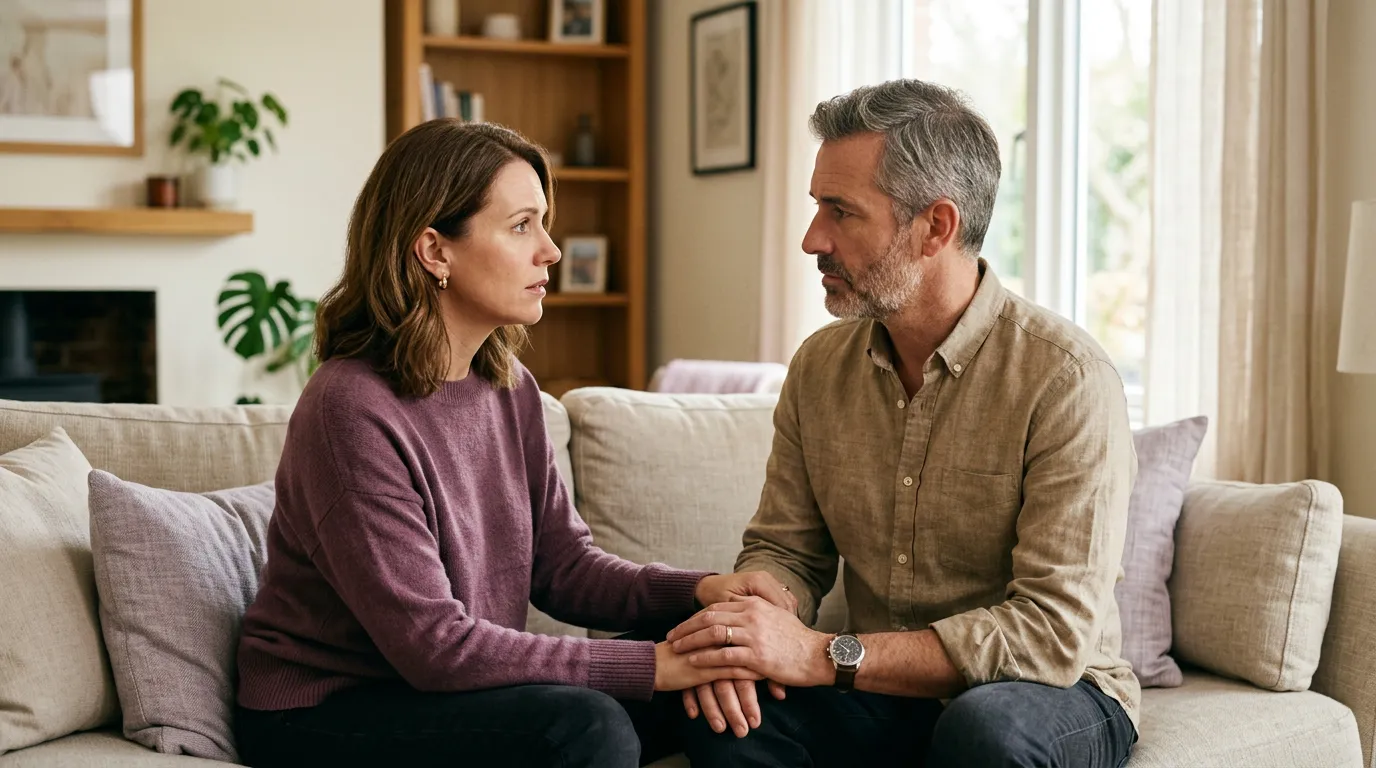
How affair recovery is staged
Recovery usually moves through four stages, and clinicians keep the order steady so that no one is rushed.
- Stabilization: surviving the acute phase, which covers sleep, safety, what the children are told and how two people live under one roof for now
- Honest disclosure: an organized telling of what took place, timed so it informs the partner without causing fresh injury
- Understanding the affair: examining the conditions that allowed it, an exercise that explains and does not excuse
- Rebuilding or releasing: regaining trust through transparency and repair, or closing the relationship on purpose and with dignity
A word on disclosure is in order. Interrogation at two in the morning is not disclosure, and it tends to injure both people. A clinician helps you decide what needs to be known, when, and in what setting, so that the answers can be absorbed.
Understanding the cause is not the same as forgiving it. Trust cannot be rebuilt without an explanation, however, and the work of building that explanation can be one of the most clarifying parts of treatment.
Julie Potischman, PhD, LPC, NCC, CST and Beth Levy-Merlin, PhD, MSW, LCSW are the clinicians who see clients for infidelity therapy.
A clinician who is not a judge
Recovery from an affair stalls fast if sessions begin to resemble a courtroom. Someone who was betrayed needs the harm recognized in full, with no downplaying and no pressure to forgive quickly. The partner who strayed must be seen as a person who caused harm, and not as someone on permanent trial.
Nobody can do honest recovery work while constantly protecting themselves. Keeping both truths in view together falls to the clinician and requires real skill. Each partner is owed equal rigor and equal respect.
The work asks you to take responsibility, and it also needs a clinician who sees you as a whole person and not as a verdict. If you are the one who had the affair, you will not be treated as the villain of the story.
The same approach applies to an emotional affair with no physical contact, an online relationship or a secret financial life. Much of the damage lies in the concealment and the closeness given to someone else, rather than in a single event.
When the affair involves sexual concerns in the marriage, whether they came before it or after, the practice's sex therapists, who hold the CST credential, can take part in treatment. Our sex therapy page for Parsippany explains that work.
Coming alone, and the children
Not everyone comes as a couple. Some betrayed partners come alone, because their partner refuses therapy or because the relationship has ended and the injury remains. Some people who had an affair come alone to understand why. Individual therapy after betrayal, on either side of it, is standard practice here, and it helps whether or not the relationship continues.
If your partner will not come, there is still a point to starting. A pattern can change when one person changes how they respond, and you get a place to think clearly while the situation is unsettled.
Children complicate the picture. They often sense that something has happened even when nothing has been said. Therapy can help parents decide what to say, what not to say and how to keep ordinary routines steady while the adults work through the crisis.
Our commitment is to an honest process, with no outcome favored in advance. No clinician can promise that a relationship survives an affair. Many do when both partners commit, and the practice gives the relationship its best honest chance, as well as a humane way through if it ends.
When the marriage itself is the open question
Some couples come in unsure whether the marriage can continue at all. In that case, discernment-style work can run alongside affair recovery. It is short and structured, and it aims at a clear decision made together rather than at a repaired marriage.
Our marriage therapy page for Parsippany describes that work in more detail, and the two can be combined at the same practice with the same clinician or with a colleague, depending on what you prefer.
Affair recovery usually takes many months, not a few sessions, because trust is rebuilt through steady change over time. The pace depends on the couple, on how the affair came out and on how each partner is coping. Your clinician helps you track progress through each stage and adjusts the plan as needed.
Some partners also benefit from individual sessions along the way. The sleep, anxiety and low mood that follow a betrayal are real and can be treated, and you do not have to wait for the couple's work to finish before asking for that help.
If you want a place to take those symptoms on their own, ask the office when you call, and it will suggest how to arrange it.
Privacy and travel for infidelity therapy in Parsippany
Confidentiality weighs heavily here, and certain clients prefer to avoid waiting rooms altogether. Roseland Psychotherapy Associates offers secure video anywhere in New Jersey, so you can join from home, or from two separate locations during a separation.
If you prefer to come in, our office is about 10 minutes and 7.5 miles from Parsippany, reached by routes that include CR 611, I-280 and I-80. Parsippany-Troy Hills is a township of about 56,600 people, and an office 7.5 miles away puts your sessions outside your own neighborhood. Parking costs nothing in front of or beside the building, and Suite 103 of 425 Eagle Rock Avenue is on the first floor.
Weekday, evening and weekend appointments are available by scheduling, so sessions can fit around work and childcare without announcing themselves. Couples can also mix formats, with one partner in the office and the other on video if that is easier during a separation.
Call (973) 226-1505 or use the contact page to request a time. No referral is needed, and the office can check your insurance coverage when you call.

Further reading: American Association for Marriage and Family Therapy.
Who you'd see
Clinicians who treat Infidelity


Infidelity therapy for Parsippany: getting here
Usual route: Eagle Rock Avenue (CR 611), I-280, I-80.
Roseland Psychotherapy Associates
425 Eagle Rock Avenue, Suite 103
Roseland, NJ 07068 · (973) 226-1505 · Open in Maps
How to get started
Call or request a time
Call (973) 226-1505 or use the appointment form. Our office answers questions and can check your insurance coverage.
We match you
Tell us what is going on and when you are free. We pair you with the licensed clinician on our team who fits your concern and schedule.
Start in person or by video
Meet at 425 Eagle Rock Avenue with free parking, or log in from home in Parsippany. You can switch between the two as life changes.
Infidelity therapy in Parsippany: questions
Still unsure? Call (973) 226-1505 and ask us directly.
Is there an infidelity therapist near Parsippany?
Yes. Roseland Psychotherapy Associates is about 10 minutes from Parsippany at 425 Eagle Rock Avenue in Roseland. Clinicians provide structured affair recovery for couples and individuals, in person or by secure video. Call (973) 226-1505 and the office will match you with a clinician and set up a first appointment.
When should we start therapy after an affair is discovered?
Usually soon after, while emotions are raw and decisions feel urgent. Early sessions focus on getting through the crisis, including sleep, what to tell children and how to share a house. Waiting often lets painful patterns harden. You do not have to make any decisions about the relationship before you call.
Do we attend together or separately?
Usually both. Sessions with both partners handle the shared work, and the individual meetings early on let each person voice what is not yet sayable with the other present. Your clinician plans the structure with you and changes it as the work moves through each stage.
My partner will not come. Is there any point in starting?
Yes. Individual therapy after betrayal is standard practice here, and it helps whether or not the relationship continues. You can work on sleep, anxiety, decisions and the next steps on your own. The office at (973) 226-1505 can introduce you to a suitable clinician.
Can infidelity therapy be done by video from Parsippany?
Yes. Secure video is available anywhere in New Jersey and works well when partners live apart, have demanding schedules or want extra privacy. Some couples prefer meeting in person at the Roseland office, with free parking and evening and weekend times. Your clinician can help you decide which setting supports the work.
Does insurance cover infidelity therapy?
Coverage depends on your plan and on whether sessions are individual or joint. Call (973) 226-1505, give the office your details, and we can check your coverage before the first appointment. You do not need a referral to begin.
Call or text (973) 226-1505
We'd love to hear from you. Tell us a little about what's going on and we'll match you with the therapist who fits you best, and check your insurance while we're at it. If you already know who you'd like to see, we'll book you with them. No referral needed. Press 0 for scheduling.
Weekday, evening and weekend appointments. Most major insurance accepted.