
Service areas / Irvington / Infidelity therapy
Infidelity therapy in Irvington, NJ
Roseland Psychotherapy Associates provides infidelity therapy in Irvington for couples and individuals after an affair. Our Roseland office is about 17 minutes from the township, and secure video sessions offer added privacy anywhere in New Jersey.
About 17 minutes from Irvington to our Roseland office. Secure video anywhere in New Jersey. No referral needed.
Quick answer
Looking for infidelity therapy in Irvington? Roseland Psychotherapy Associates, at 425 Eagle Rock Avenue in Roseland, is about 17 minutes (11 miles) from the township. Licensed clinicians guide couples and individuals through affair recovery, either in person or by secure video. No referral is needed. Call (973) 226-1505 to start today.
The first days after an affair comes to light
Right after the truth comes out, most households go through the same pattern. People stop sleeping and stop eating. They ask the same questions over and over. A spouse of many years can start to feel like an unfamiliar person. Many betrayed partners report reactions that look like trauma, including unwanted mental pictures, a body that never relaxes and a compulsion to check. Clinically, the comparison holds.
Big questions about the future can wait at this stage. The first task of infidelity therapy in Irvington, or anywhere, is to steady two people in acute distress, one of whom may feel unable to leave the house and the other unable to stay in it. The first meetings focus on rest, safety, what the children are told, and how two people live under one roof for the coming week. Decisions can wait.
You do not need a plan to call. Plenty of couples start affair recovery uncertain about staying married, and treatment can begin without that being resolved.
If you are the partner who had the affair, you are also welcome. The work asks you to take responsibility, and it needs a clinician who sees you as a whole person instead of a verdict. If the distress feels like more than you can carry, ask for an early appointment. If you feel unable to cope, call or text 988, the Suicide and Crisis Lifeline, at any hour.
 Clinically reviewed by Julie Potischman, PhD, LPC, NCC, CST, partner and co-founder of Roseland Psychotherapy Associates and an AASECT-certified sex therapist. Meet the team.
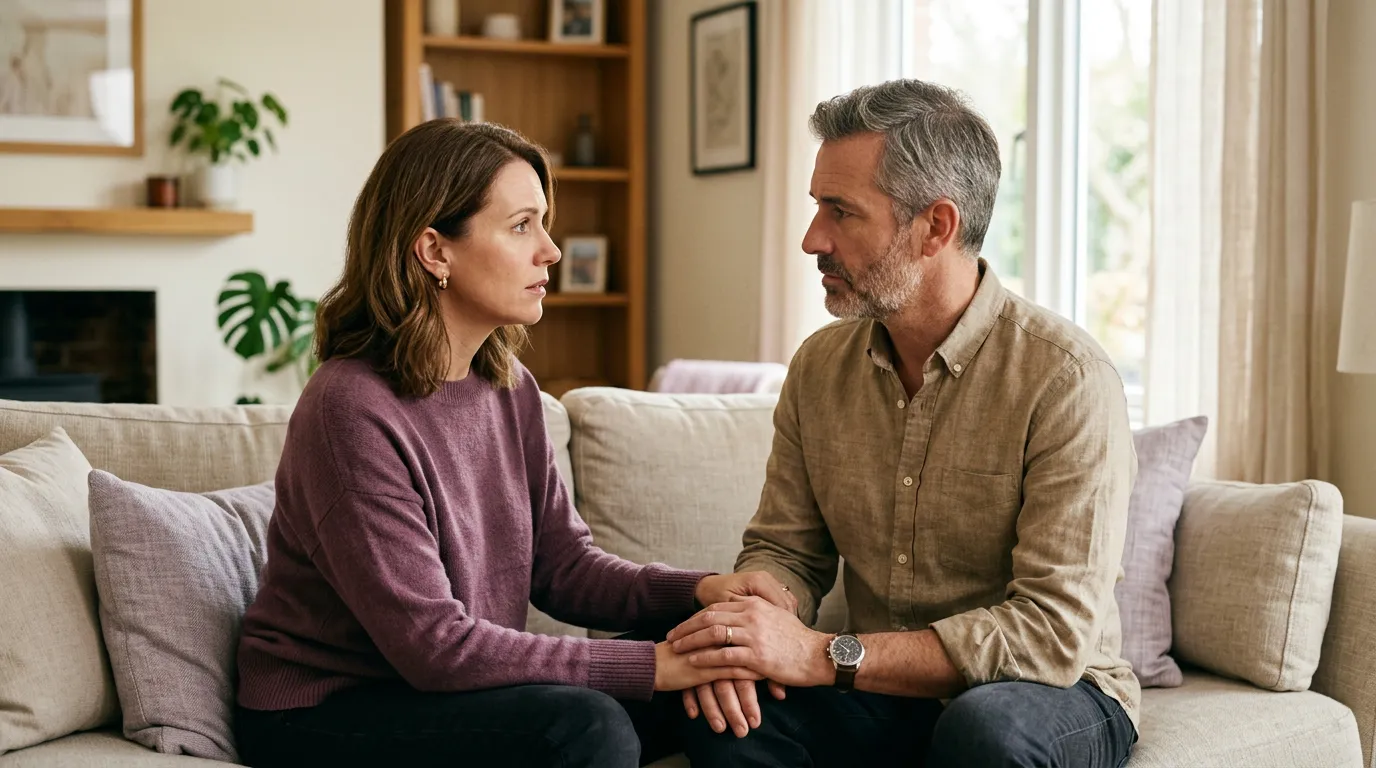
How affair recovery is usually staged
Recovery tends to move through four stages, though real couples loop back and forth between them.
- Stabilization. Weathering the acute crisis: sleep, safety, the children's questions and a workable arrangement at home for the time being.
- Honest disclosure. A guided telling of the facts, with the clinician setting the pace so the account clarifies without causing fresh injury. Interrogation at 2 a.m. is not disclosure.
- Understanding the affair. Looking at how it became possible. Understanding is not the same as excusing, though rebuilding trust requires it.
- Rebuilding or releasing. Either regaining trust through transparency and repair, or closing the relationship on purpose and with respect.
Recovery stalls fast once sessions start to feel like a courtroom. The betrayed partner needs the injury acknowledged in full, without minimizing and without being hurried toward forgiveness. The partner who strayed should be treated as a person who caused harm, and not as someone who stays on trial forever. Someone stuck in self-defense has no room for the candid effort that healing demands.
Keeping both needs in view together falls to the clinician, and doing it well is a skill. Expect your clinician to set ground rules early about what gets discussed in session, what waits, and how to handle the urge to check a phone or a calendar between appointments.
Who in the practice can help
Two clinicians see clients for this work: Julie Potischman, PhD, LPC, NCC, CST, a partner and co-founder of the practice, and Beth Levy-Merlin, PhD, MSW, LCSW, also a partner and co-founder. When you call, the office hears a short description of what has happened and matches you with whoever seems the better fit.
When an affair involves sexual concerns in the marriage, whether they came before it or after, the practice's certified sex therapists can take part in treatment. Our sex therapy page for Irvington explains what that work looks like. You do not have to start over with a new practice.
Not everyone comes as a couple. Certain betrayed partners attend by themselves, either because a spouse will not take part or because the relationship is over while its effects are not. People who had an affair also come for individual work, to understand what they did, to decide whether to disclose it, or to stop living a double life. A partner's affair discovered years ago can come up long after the marriage itself has moved on.
We treat all of these here, without judgment, and the individual track can run beside couple work or on its own. Privacy rules are explained at the start of treatment, so you know who knows what.
Deciding what comes next
Recovery does not assume the couple will reconcile. Some couples emerge with a relationship they describe as more honest than the one they had before. Others decide, carefully, that the marriage is over. Sessions then help them part with as little lasting harm as possible, which counts for a lot when there are children.
The commitment is to an honest process, with no preferred result in mind. No clinician can promise that a relationship will survive an affair. Many do when both partners commit to recovery, and therapy gives the relationship a structure and its best honest chance, along with a humane way through if it ends.
An emotional affair with no physical contact is treated with the same approach. What hurts most is the concealment and the closeness given to someone else, more than any one act. The same goes for online relationships and secret financial lives.
When the future of the marriage itself is the open question, discernment-style work can run alongside. Our marriage therapy page for Irvington describes it, and the main infidelity therapy page covers the approach in full.
Early on, individual sessions can give each partner room to say what cannot yet be said in front of the other.
Privacy, scheduling and how to begin
Privacy is a real concern in this kind of work, and some clients would rather not sit in any waiting room. Clients anywhere in New Jersey can use secure video. You can join from home, or from two separate locations if you are living apart for now.
Times on weekdays, evenings and weekends can be arranged through scheduling. Joint sessions usually run 45 to 60 minutes, and the structure is planned with you, including how often individual time comes into the mix.
Calling is simple. You can say that you are looking for help after an affair, and nothing graphic is asked on the phone. The office takes basic details, discusses timing and matches you with a clinician. If you would rather write, the appointment request form is available.
Some people call the same day they learn about an affair. Others wait years. There is no required timing, and a first session can be as modest as telling your story to someone whose only job is to listen and keep the room safe.
If you are not sure that you want your spouse to know you called, say so. The office will explain how to schedule a first visit in a way that fits your situation.
Getting from Irvington to a private office
Our office is about 17 minutes and 11 miles from Irvington, reached by routes such as County Road 611, County Road 527, I-280, Freeway Drive East and Western Parkway. Nearby towns include Maplewood, South Orange, East Orange, Newark, Orange and Millburn. Find the office in Suite 103 at 425 Eagle Rock Avenue, on the first floor, where parking is free on the front and side of the property and wheelchair-accessible walkways.
Some people feel more comfortable seeking infidelity therapy in Irvington by video, so that no one in town sees them arrive at an appointment. Secure video is open to anyone in New Jersey, and many clients start there and move to the office later, or the reverse. Appointments are offered on weekdays, evenings and weekends by scheduling.
Irvington is a township of about 61,000 people in Essex County, and you may prefer an office outside your own town, or the screen. Either choice is fine, and you can change your mind between sessions. Call (973) 226-1505 to schedule. You do not need a referral, and the office can check your insurance coverage when you call.

Further reading: American Association for Marriage and Family Therapy.
Who you'd see
Clinicians who treat Infidelity


Infidelity therapy for Irvington: getting here
Usual route: Eagle Rock Avenue (CR 611), CR 527, I-280, Freeway Drive East.
Roseland Psychotherapy Associates
425 Eagle Rock Avenue, Suite 103
Roseland, NJ 07068 · (973) 226-1505 · Open in Maps
Nearby towns we also serve
How to get started
Call or request a time
Call (973) 226-1505 or use the appointment form. Our office answers questions and can check your insurance coverage.
We match you
Tell us what is going on and when you are free. We pair you with the licensed clinician on our team who fits your concern and schedule.
Start in person or by video
Meet at 425 Eagle Rock Avenue with free parking, or log in from home in Irvington. You can switch between the two as life changes.
Infidelity therapy in Irvington: questions
Still unsure? Call (973) 226-1505 and ask us directly.
Is there infidelity therapy near Irvington?
Yes. Roseland Psychotherapy Associates is about 17 minutes from Irvington in Roseland, with licensed clinicians who guide couples and individuals through affair recovery. Sessions are in a private first-floor office or by secure video. Phone the office at (973) 226-1505 to be paired with a clinician.
Can a relationship survive an affair?
A good number of relationships come through it when both people commit to recovering. Nobody can promise an outcome for any given couple. Therapy gives the relationship a structure and its best honest chance, along with a humane way through if it ends. You do not need to decide anything before your first session.
Do we attend together or separately?
Usually both. Joint sessions carry the couple's work, and early on individual sessions give each partner room to say what cannot yet be said in front of the other. Some people attend alone because their partner declines. Your clinician plans the structure with you and adjusts it as things develop.
What about an emotional affair with no physical contact?
The damage lies in the hiding and in the closeness given to another person rather than in a specific act. We use the same recovery approach for emotional affairs, online relationships and secret financial lives. If it hurts and trust is broken, it belongs in the room, and you do not have to prove it is serious enough.
I had the affair. Will the therapist be against me?
No. The work asks you to take responsibility, and it also needs a clinician who sees you as a whole person and not as a verdict. Both partners should expect the same respect, and neither is cast as the villain. Individual sessions are available if you want to work on your own side first.
Does insurance cover infidelity therapy?
Coverage depends on your plan. Call (973) 226-1505 and the office can check your insurance coverage when you call, before your first appointment. You do not need a referral to book. If privacy is a concern, tell the office when you call and they will explain your scheduling options, including secure video.
Call or text (973) 226-1505
We'd love to hear from you. Tell us a little about what's going on and we'll match you with the therapist who fits you best, and check your insurance while we're at it. If you already know who you'd like to see, we'll book you with them. No referral needed. Press 0 for scheduling.
Weekday, evening and weekend appointments. Most major insurance accepted.